Bonnie MacLean’s pioneering poster art in 1967
A splashy LIFE magazine cover story in the fall of 1967 hyped what was a rapidly growing, nationwide interest in posters back then. Its author, a seasoned art critic and contributing editor at Time named Jon Borgzinner, relegated a good deal of space in his piece to San Francisco’s psychedelic posters.
“At first, psychedelic poster art appears to look like logs of LSD trips, but it is also derived playfully from past and banal images,” wrote Borgzinner in “The Great Poster Wave.” The feature highlighted the medium’s fervent consumer base as well as the era’s bustling poster shops and offered a detailed celebration of the psychedelic poster scene’s male artists.
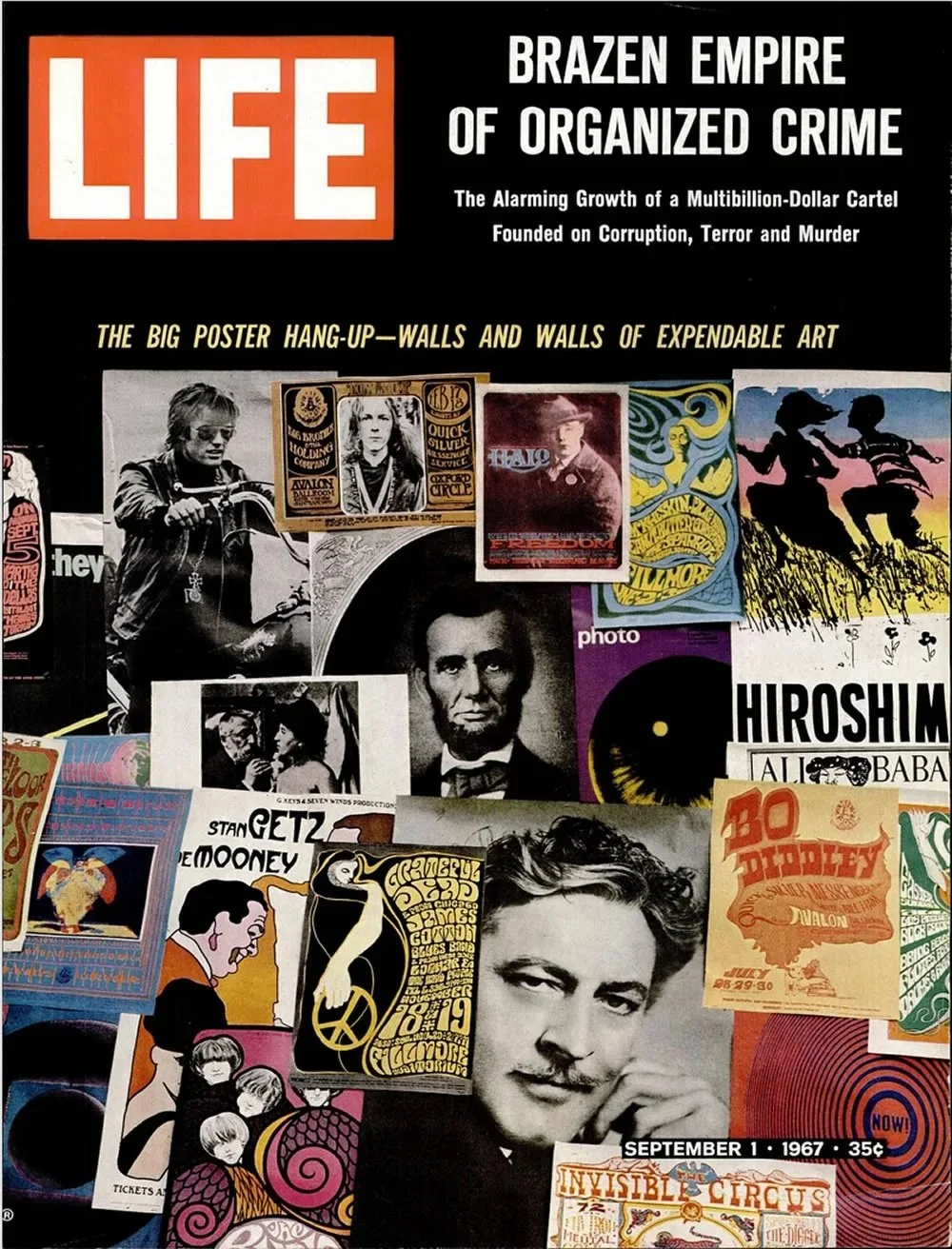
“The art of poster-making has its own avant-garde, the foremost of whom are shown here,” reported Borgzinner of male psychedelic artists Victor Moscoso, Wes Wilson, Peter Max, and Stanley “Mouse” Miller. The men of the poster scene were interviewed and granted portrait photos in this, one of the most well-read mass-market weeklies in the United States, with their names appearing in captions for each. Meanwhile, a group shot featuring poster artist Donna Herrick that was initially intended for inclusion didn’t make it into the layout. The men of “The Great Poster Wave” again nabbed top billing in a prominent magazine story in 1967, just as they had in stories published by Newsweek and Time in months prior.
At the time, LIFE boasted more than eight million subscribers. Its publisher was one of the largest news organizations in the world, and research has shown that in its heyday, it regularly reached one-quarter of America’s population. A few months after LIFE’s staff was presented with the National Magazine Award, the September 1st issue hit newsstands. And in its eight-page feature on posters, artist Bonnie MacLean—one of the psychedelic poster scene’s leading figures and a pioneer of the pervasive psychedelic aesthetic that defined the period—was nowhere to be found.
A native of Philadelphia, MacLean majored in French at Penn State. She later enrolled in figure-drawing classes at Brooklyn’s Pratt Institute at night, and that’s the only formal art training in her background that I know of. In 1963, she headed west. Within a few years of her arrival in San Francisco, MacLean began to quickly build what became a modest but treasured body of design work—a run of collectible rock concert posters that promoted shows at the Fillmore Auditorium and Winterland Ballroom, venues operated by her then-husband Bill Graham. Seven of these posters are currently on view at the Cooper Hewitt, Smithsonian Design Museum as part of the “Art of Noise” show. The exhibition runs through August 16th, 2026, and explores how design informs our experiences with music.
Alongside the other overlooked female rock poster artists of the 1960s, MacLean has belatedly seen some acclaim since her death in 2020. But she’s hardly one of the marquee names associated with the culture of psychedelic poster art, which is today the subject of lavish art books, exhibitions, auctions, and documentary films. The collectibility and legitimacy of the style was buoyed in part by two significant events in 1967—the big LIFE cover story was the second of the pair, and neither of which included MacLean’s work.
During California’s so-called “Summer of Love,” the psychedelic poster art movement “entered its mature stage,” wrote University of Denver art history professor Scott B. Montgomery, in 2018, in The Sixties: A Journal of History, Politics, and Culture. Prior to LIFE’s big feature on the subject, a popular exhibition of psychedelic poster art called “The Joint Show” was staged in San Francisco, at the blistering-hot center of the poster explosion.
Here’s Montgomery:
“In concept and execution, the Joint Show presented itself as a bona-fide art event—an exhibition of New High Art. In doing so, it valorized a countercultural aesthetic in the same language and ritual of display that the older, dominant, ‘straight’ culture used to assert and legitimize its own hegemony—the art exhibition.”
At the Moore Gallery on Sutter Street in San Francisco, “The Joint Show” opened in July 1967 and reportedly closed in early September. The gallery sought out the poster scene’s celebrities, and the exhibition’s poster designs and other works on paper were strictly confined to art created by “The Big Five”—Stanley Mouse, Alton Kelley, Rick Griffin, Victor Moscoso, and Wes Wilson. An incredibly talented group, but wow, it’s just men.
In a separate article, a remembrance of MacLean and Wilson published in 2020, Montgomery noted that “in the early weeks of the Fillmore, the visual element was dominated by Wes Wilson and Bonnie MacLean,” and MacLean’s “lack of inclusion in the Joint Show meant that we have a Big Five and not a Big Six.”
Inspiration behind the work that MacLean and others created during the 1960s included Art Deco, Art Nouveau design, commercial artists of the era such as Milton Glaser, superhero comics drawn by Jack Kirby—yep, that’s Thor in the upper left corner of Paul Foster’s poster for an Acid Test in 1965—and of course, the effects of the copious psychotropic drugs that were circulating through Haight-Ashbury. (MacLean didn’t dabble in the latter.)
“Psychedelic imagery was not wholly unknown in the art world, as it infused aspects of Dada, Surrealism, and postwar American Pop Art,” wrote Montgomery. “But the art of the emerging psychedelic counterculture was yet to be noticed within the greater world of art galleries and criticism. The Joint Show was not just the art world going psychedelic, but was also the psychedelic world going art.”
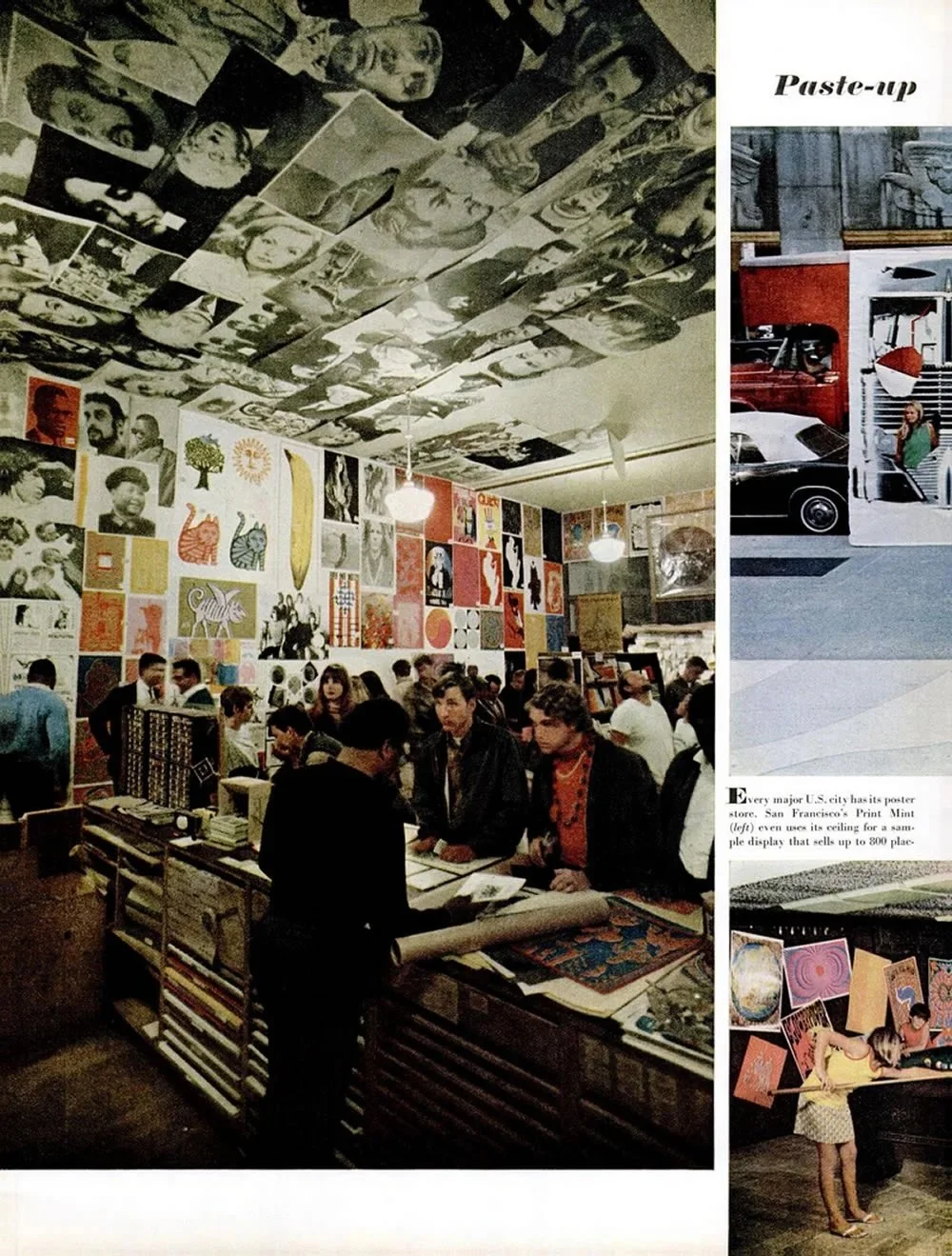
The dazzling and visually diverse posters featured in “The Joint Show,” as well as the bulk of psychedelic posters in general that were made between 1966 and 1968, were done so using photo-offset lithography and were printed in the small print shops that dotted San Francisco. The LIFE feature included a spectacular interior photo of a very busy day at the Haight retail location of the Print Mint, which eventually established a publishing arm. In 1968, the company published the revolutionary underground comix series Zap, which rejected the industry-crushing Comics Code Authority and was the target of police raids and obscenity lawsuits. Zap was every bit the “boys club” that the psychedelic poster scene was, and alongside strips authored by titans of the form such as Manuel “Spain” Rodriguez, the series ran comic art by Victor Moscoso and Rick Griffin.
Artist Wes Wilson worked as a layout designer at one of the shops, Contact Printing, which was the vendor that Bill Graham used to get his early handbills printed up. (The promoter collaborated with Tea Lautrec for poster production beginning in 1967, and that fruitful relationship resulted in more than 200 psychedelic posters over four years.)
Wilson eventually secured regular poster-making gigs for Graham and for the Family Dog-sponsored shows at the Avalon Ballroom. But by the time the Moore Gallery contacted Wilson with the concept for its star-studded group show, Wilson and Graham had fallen out over money, and Graham replaced Wilson with MacLean.
MacLean was Graham’s secretary before she went on to play a pivotal role in the concert promoter’s takeover of the Fillmore Auditorium, illustrating the venue’s interior advertisement board weekly to highlight the current slate of concerts and get the word out about shows that were on the horizon. She took tickets in the box office and handled other tasks when Graham’s events were getting off the ground, too. In 1966, “Bill Graham Presents” programming included local acts Quicksilver Messenger Service and Jefferson Airplane, as well as New York City’s Velvet Underground, not long before they lugged their gear north for the first of many consecutive gigs in Boston. MacLean’s earliest poster for Graham came to fruition in the spring of that year, and in June 1967, MacLean and Graham were married.
The estimated 3,500 or so guests of the opening reception of “The Joint Show” on Sutter Street in July—possibly “the most raucous art opening of the year”—wouldn’t have discovered MacLean’s work on the walls even though she “was indeed one of the most visible poster artists on the scene,” wrote Montgomery. Of the legacy of “The Joint Show,” he added:
“In crucial ways, the show shaped subsequent discourse on psychedelic poster art. It honored and elevated the poster artists, galvanized the poster movement, and inspired other artists. For the counterculture, the show represented an artistic victory.”
As compared to her male peers, MacLean hadn’t been creating poster designs consistently for very long when the Moore Gallery staged its group show. But given her prominence in the culture when LIFE’s big story went to press months later, her absence from the article isn't as easily forgivable. She didn’t enjoy the recognition that the male poster designers had, and this owed at least in part to the era’s rampant misogyny as well as her closeness to Bill Graham. (MacLean “occupied a difficult position vis-a-vis the rival factions surrounding Graham,” notes Montgomery.)
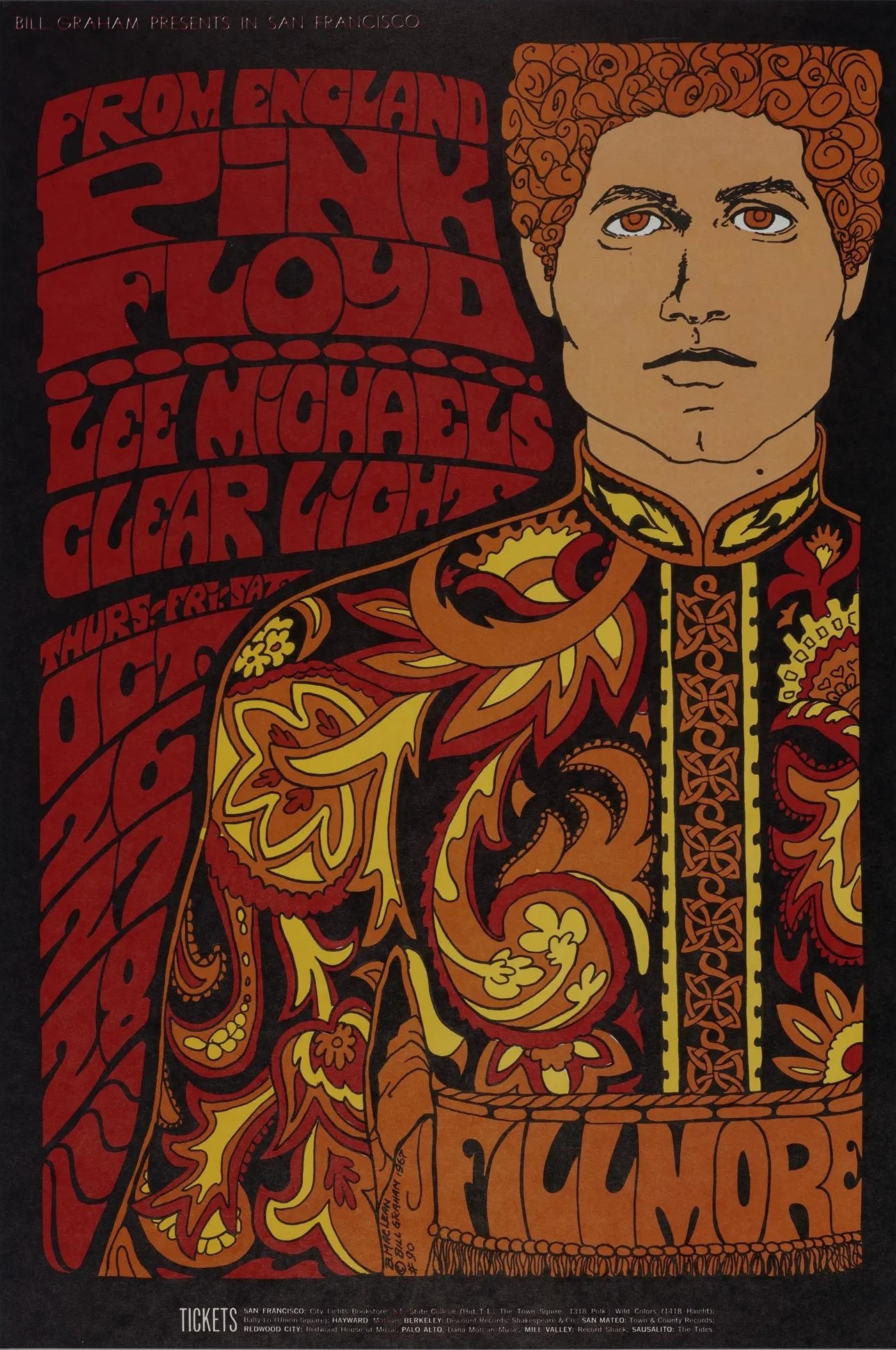
When MacLean took over for Wes Wilson as Graham’s in-house artist, she deftly introduced feminine forms, contrasting colors, and blotty nebulae plucked from the heavens into more than 30 expressive posters that publicized shows by Jimi Hendrix, the Grateful Dead, the Yardbirds, and other legendary acts of the era. The rubbery headliners’ names brush up against porcelain-faced human figures in her work, and it yields messaging that is wonderfully illegible, with the individual letters becoming wobbly or flattened altogether owing to the weight of adjacent architectural elements or knotty, natural-world motifs.
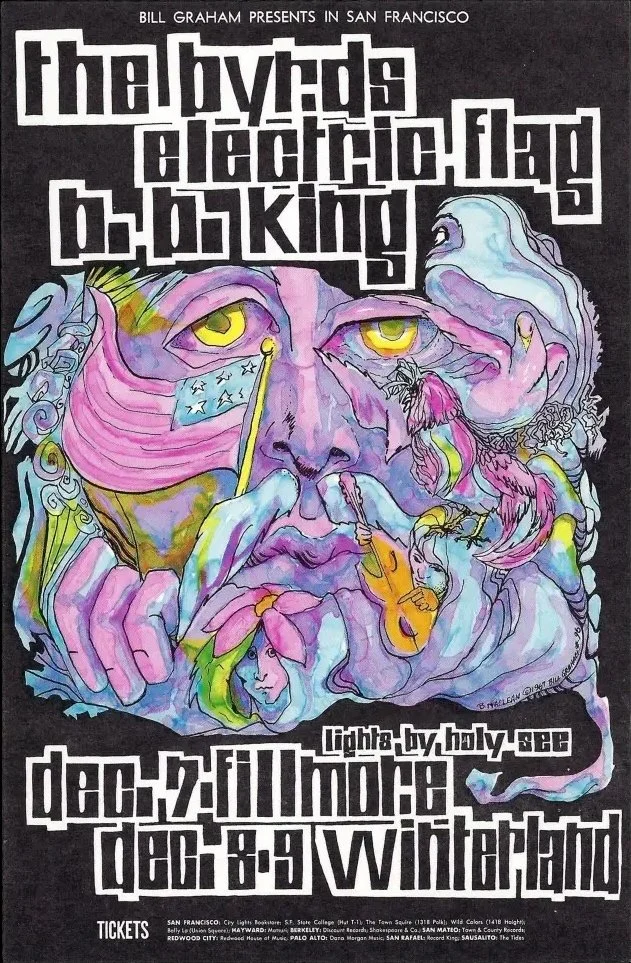
It’s tough not to totally fall in love with MacLean’s psychedelic poster for a run of shows in late 1967 starring the Byrds, Electric Flag, and B.B. King, featuring lights by a collective called Holy See. This artwork—an offset lithograph on wove paper and a standout on the wall at the Cooper Hewitt—is known to collectors as BG #96. The “BG” stands for Bill Graham’s concert series.
Go ahead and take in how the soft washes of pink and purple pop against the black backdrop and comparatively angular, graphic edges of the hand-lettered band names; the ornate linework that frames the mysterious swirl of faces, flags, instruments, flowers, and other motifs at the center; and MacLean’s heavily illustrative approach versus the period’s better-known collagist experiments by fellow poster artists Stanley “Mouse” Miller and Alton Kelley—pretty remarkable stuff.
In The Sixties, Scott B. Montgomery writes about another factor that worked against MacLean. Her work was ephemeral in that the board she illustrated every week to promote shows at the Fillmore would need repainting again and again. Given the impermanence of these important contributions, it is perhaps all the more striking that her place as a trailblazing force in psychedelic poster art endures.
“It is only with her ascendancy to the role of Bill Graham’s principal poster designer, after the promoter’s acrimonious split with Wes Wilson, that MacLean’s role is generally acknowledged,” writes Montgomery. “But she was on the scene, designing its visual culture, from the very beginning.”
See Bonnie MacLean’s work in "Art of Noise," which is on view at Cooper Hewitt, Smithsonian Design Museum in New York City through August 16, 2026.
Cover, LIFE magazine © 1967 Henry Groskinsky for Time Inc. “Pink Floyd, Lee Michaels, and Clear Light, October 26–28, Fillmore Auditorium, 1967” (BG #90) © 1967 Bonnie MacLean. Interior, the Print Mint, San Francisco © 1967 Ted Streshinsky for Time Inc. “The Byrds, Electric Flag, and B.B. King, December 7–9, Fillmore Auditorium & Winterland, 1967” (BG #96) © 1967 Bonnie MacLean.
