Milton Glaser’s psychedelic art for The Electric Kool-Aid Acid Test
June 26, 2026—In support of a feature story on acid trips, a lively piece of psychedelic Pop art ran on the cover of what would become New York magazine in January of 1967. Created by the late legendary commercial artist Milton Glaser—a luminary of 20th-century graphic design who gave us I 🖤 NY—the image accompanied the lead article’s account of the broadening popularity of lysergic acid diethylamide (LSD) and its effects on a communally living troupe of performance artist-acidheads in California.
With its bubbly energy and rich, saturated colors, Glaser’s illustration was appropriately effervescent given the story’s subject. When the piece’s author, Tom Wolfe, eventually expanded the focus of his reporting, which first ran in three installments in the Sunday supplement of New York City’s short-lived World Journal Tribune newspaper, a full-length book called The Electric Kool-Aid Acid Test was born with Glaser’s work on the jacket. It has shown up again over the years, most recently on the cover of 2023’s Milton Glaser: Pop. And like the rest of Glaser’s visuals, we're still swooning over it.
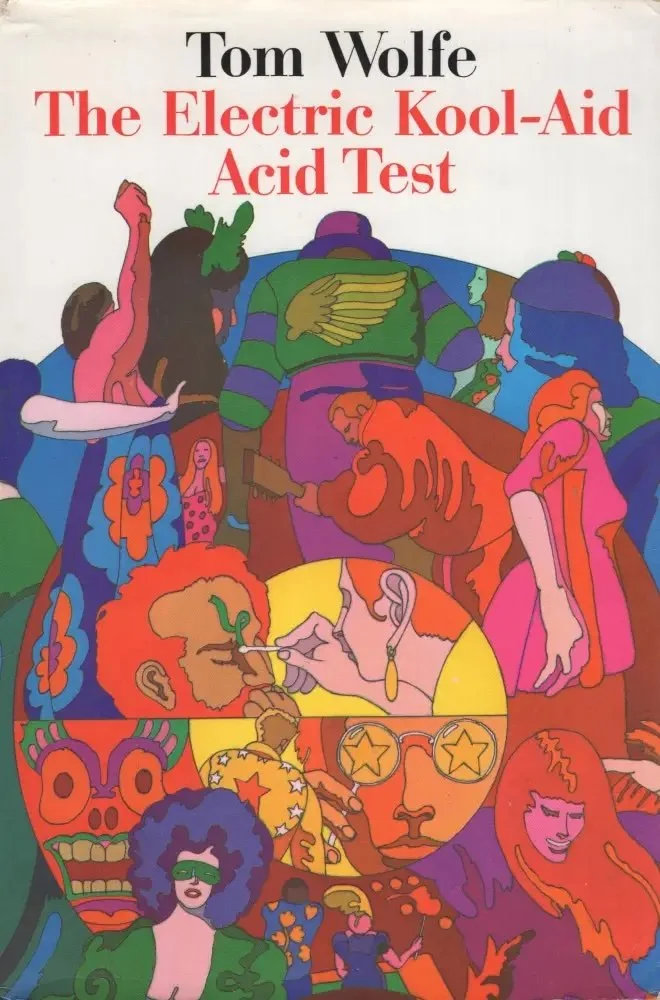
Glaser cofounded a pioneering design house called Push Pin Studios with like-minded artists Edward Sorel and Seymour Chwast in the mid-1950s (Reynold Ruffins became a partner later), and there are commonalities between the collagist Electric Kool-Aid Acid Test art and the charming designs that he created for his commercial clients at the firm.
Admirers of the delightfully vivid Time magazine cover Glaser designed for its November 7, 1969, issue and other pieces of the period should be familiar with the materials behind this mixed media work—pen, ink, and strips of colored plastic film called Cello-Tak (a Push Pin house favorite).
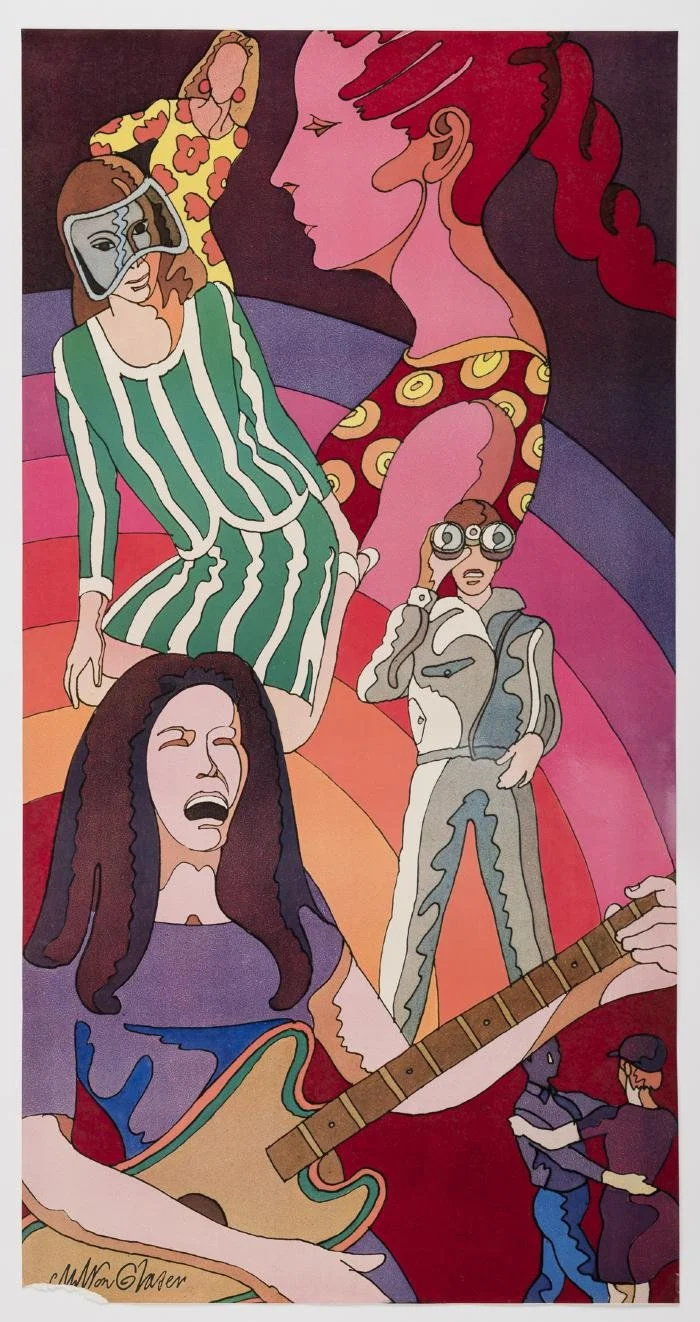
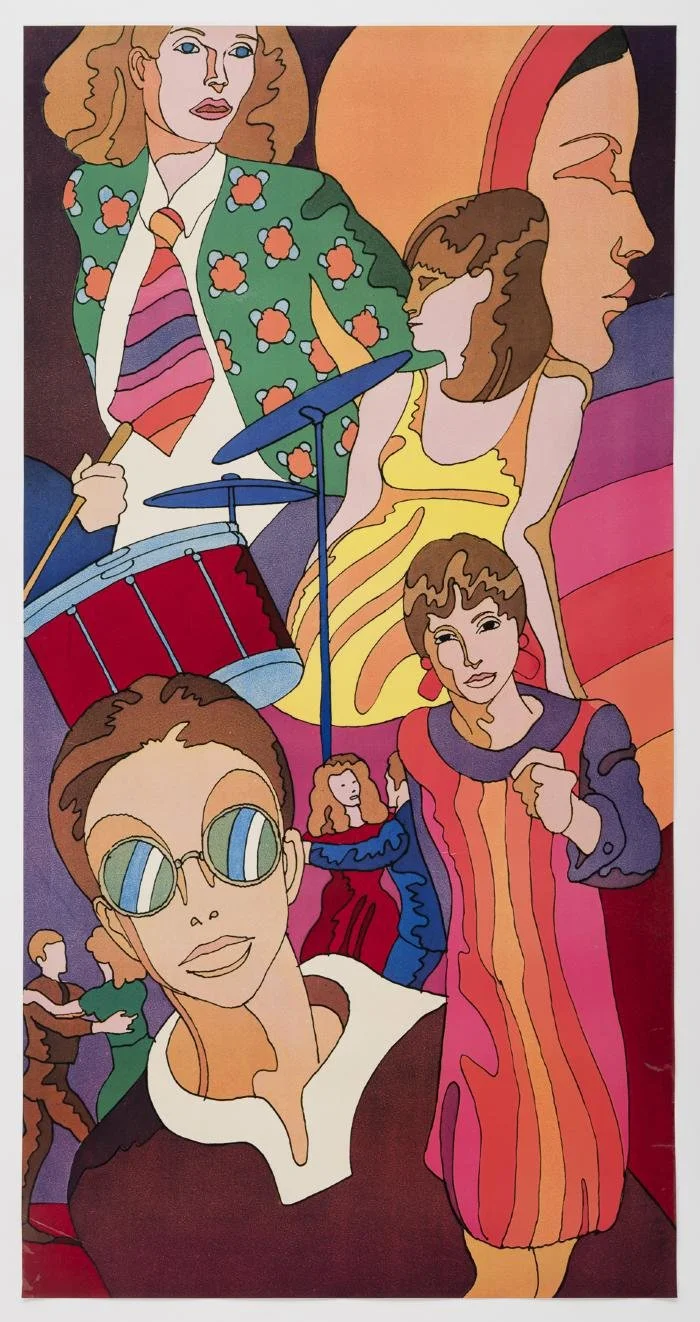
The Electric Kool-Aid piece’s stars, flowers, and other motifs—as well as the playful graphic patterns emblazoned on his figures’ skirts, jackets, and sundresses here—materialize elsewhere in Glaser’s art. The swirling silhouettes and bulbous, rubbery shadows can likewise be found in his various commissions of the era and, in particular, in the offset lithograph poster art he created for CBS Records in 1966 as part of the marketing campaign for a Bob Dylan compilation LP.
Just as Glaser found inspiration in the fluid linework that characterized the Art Nouveau posters of the late 19th century—as well as the abundance of natural-world motifs in those advertisements and other Nouveau designs—so, too, did the psychedelic rock poster artists of the 1960s.
Victor Moscoso, an illustrator and underground comix artist who created ‘60s-era handbills for the Fillmore Auditorium and other rock venues, also paid homage to Art Nouveau and cited Glaser as an influence. And some of the pages in that Sunday magazine in January of 1967 played host to a gallery of psychedelic rock posters, imagery that augmented Tom Wolfe’s inaugural magazine reporting on LSD and partnered well with Glaser’s cover.
In its original form on newsstands, Glaser’s opulent illustration stopped just short of crashing into the elegant letterforms of the supplement’s New York masthead, presented then by way of a phototype interpretation of a typeface called Egyptienne Bold Condensed. New York had its logo, which was chosen by Glaser, but it wasn’t the popular standalone magazine yet—the periodical originated as a weekly insert of the New York Herald Tribune and, later, the World Journal Tribune. New York earned its very own place as a proper magazine in 1968, when Glaser launched the publication with editor Clay Felker. That year also saw the debut of The Electric Kool-Aid Acid Test.
In the early 1960s, the Virginia-born Wolfe was a reporter under Felker’s editorship at the New York Herald Tribune’s city desk, while Glaser turned around innovative commissions at Push Pin, such as this project for Signet Classics, which included producing deliberately unpolished book covers featuring pen-and-ink portraits of Shakespeare’s characters accented by rich watercolor washes.
During a newspaper strike in New York, Wolfe started pitching features to Esquire. When his day job resumed, he focused on similar projects for the Herald Tribune’s Sunday supplement. He was straying from by-the-book newswriting, and the copy he delivered to Felker was marked by hyper-narrative storytelling in longform pieces that blended straight reporting with literary techniques. Wolfe peppered his stories with onomatopoeia and dispensed with the rules long associated with grammar and punctuation. And while I personally don’t have the patience for such experiments, Newsweek and many others were simply over the moon about it.
Twenty-two of Wolfe’s essays were published in a book called The Kandy-Kolored Tangerine-Flake Streamline Baby in 1965, and he wrote in 1973 about what came to be known as “New Journalism” in an anthology he edited that was published under that name:
“What interested me was not simply the discovery that it was possible to write accurate non-fiction with techniques usually associated with novels and short stories. It was that—plus. It was the discovery that it was possible in non-fiction, in journalism, to use any literary device, from the traditional dialogisms of the essay to stream-of-consciousness, and to use many different kinds simultaneously, or within a relatively short space … to excite the reader both intellectually and emotionally.”
Glaser’s art for the pre-New-York-but-sorta-New-York Sunday Tribune supplement accompanied the first in a series of Wolfe’s magazine stories on psychedelic drugs and novelist-counterculture figure Ken Kesey. When Wolfe headed West with his legal notepad—and, presumably, more than one stark-white three-piece suit—he was doing so in order to learn more about the eccentric Oregon native and his cohorts. Some time had lapsed by then since Kesey had authored his breakout success, One Flew Over the Cuckoo’s Nest, a book partly written while Kesey was under the influence of psychedelics.
While finishing his fellowship in creative writing at Stanford University, Kesey volunteered to be a human test subject in labs at a nearby veterans’ hospital where he'd been working as an aide in the psychiatric ward. There Kesey ingested a whole bunch of LSD and other related substances in what he’d later learn was a series of mind-control experiments conducted by the CIA. He began drafting Cuckoo’s Nest during this time, and it was published to great acclaim in 1962.
Kesey really took a shine to acid. He indulged in it outside of the lab, and understandably, he shared it with his friends, the Merry Pranksters, a loose-knit collective of LSD-gobbling, Day Glo-paint–streaked partiers, performance artists, and other creative types. This “curious bunch of bohos,” writes Wolfe of the Pranksters in The Electric Kool-Aid Acid Test, looked to Kesey as a father figure and called him “Chief.”
Together, Kesey and his Pranksters rolled out lengthy multimedia gatherings powered by batches of then-still-legal LSD. These events evolved into the delirious Acid Tests, which featured music, light shows, and Prankster-led movie projections. They were staged in proper theaters, dance halls, wedding venues (!) such as Muir Beach Tavern, and the Fillmore.
Acid Test attendees donned lavish costumes, turned up, turned on, and immersed themselves in extended, brain-searing jams performed by a house band initially known as The Warlocks. When the Bay Area’s Warlocks found out about New York City’s Warlocks—later dubbed the Velvet Underground—they traded that name for the Grateful Dead.
The Dead played improvisational, electric-blues-charged rock at the Acid Tests. During subsequent gigs of the late 1960s, they wriggled free of any lingering structural constraints that bound them musically in the early days and worked through longform experiments onstage that owed in part to the influence of John Coltrane’s modal jazz.
Prankster Clair Brush, who worked at an underground weekly called the Los Angeles Free Press back then, was interviewed for Wolfe’s book about her experience at an Acid Test. Her recollection is in equal parts humorous and horrifying—see if it doesn’t sound like your worst nightmare:
“I looked around and people’s faces were distorted…lights were flashing everywhere…the screen (sheets) at the end of the room had three of four different films on it at once, and the strobe light was flashing faster than it had been…the band, the Grateful Dead, was playing but I couldn’t hear the music…people were dancing…someone came up to me and I shut my eyes and with a machine he projected images on the back of my eyelids (I really think this happened…I asked and there was such a machine)”
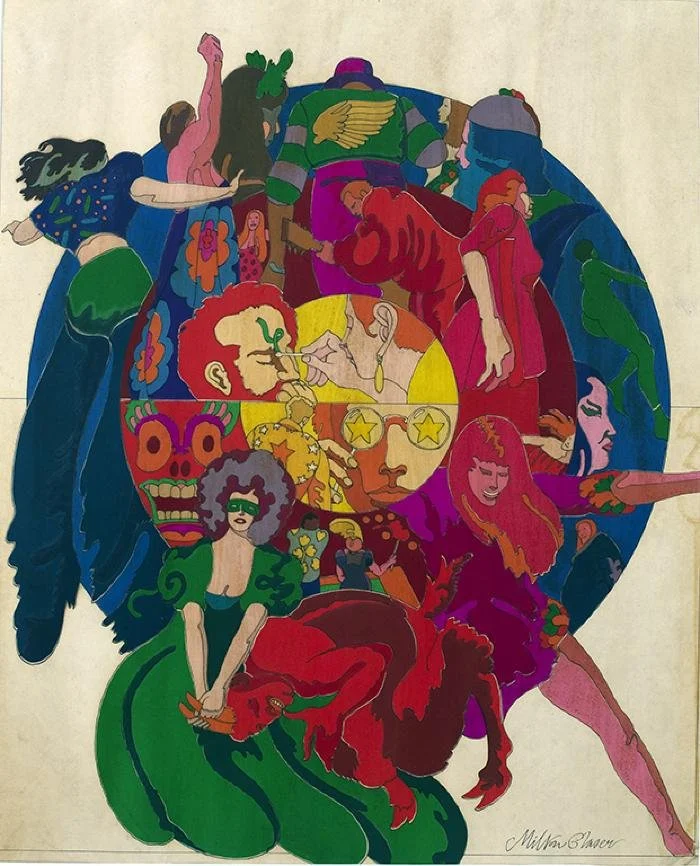
For what became his Electric Kool-Aid Acid Test illustration, Glaser gathered a cluster of dancers and musicians from the parties Wolfe profiled and carefully shepherded them onto the page. And what an eyeful—they’re outfitted in brightly colored apparel that’s flecked with his signature graphic flourishes and are bopping around, applying Day-Glo makeup, and strumming acoustic guitars. A blood-red devil, sporting horns and cloven hooves, bares its teeth as it’s physically subdued toward the bottom of the initial sketch. It’s overpowered just enough to bleed off the page so that it was nowhere to be found when the final cover design shipped to the printer.
In comparison to the dust jacket, it’s also clearer in the original art that there’s a warm, welcoming navy-blue orb hovering in the backdrop. Maybe Glaser’s blissed-out freaks are set against planet Earth as glimpsed from space, and the mossy-green nude tumbling out into the cosmos on the sketch's right side is a stand-in for vegetation. Let’s hope everyone still anchored to the ground back home is having at least half as good a time.
First-edition book cover, The Electric Kool-Aid Acid Test © 1968 Milton Glaser, Farrar, Straus and Giroux. Untitled Wall Display 2/2 and Untitled Wall Display 1/2 © 1960s Milton Glaser; New York World Journal Tribune Supplement cover art (for Tom Wolfe story) © 1967 Milton Glaser. Images courtesy School of Visual Arts Archives and the Milton Glaser Design Study Center and Archives, a division of the Visual Arts Foundation.
