Photographer Chris Steele-Perkins and Wolverhampton’s sound systems, 1978
In 1978, The Sunday Times dispatched British-Burmese photojournalist Chris Steele-Perkins to Wolverhampton, England, to cover the 10th anniversary and aftermath of a notoriously racist, anti-immigration speech delivered by Enoch Powell in nearby Birmingham.
Powell, a Tory Member of Parliament for a constituency in Wolverhampton, voiced his vehement opposition to a piece of anti-discrimination legislation called the Race Relations Act in 1968’s “Rivers of Blood” address. And when it came to clarifying his feelings about the government’s call for non-white immigration to support reconstruction in the postwar era, Powell doubled down:
“We must be mad, literally mad, as a nation to be permitting the annual inflow of some 50,000 dependants, who are for the most part the material of the future growth of the immigrant-descended population,” Powell said in his speech. “It is like watching a nation busily engaged in heaping up its own funeral pyre.”
A decade later, when Steele-Perkins was in Wolverhampton, Powell’s xenophobic address had been given new life—or its messaging was at least reintroduced to mainstream politics. Margaret Thatcher echoed its sentiments in a televised interview, suggesting that the British were “afraid that this country might be swamped by people with a different culture.”
Neither racism nor violent racist attacks on Britain’s immigrants of color were novel in 1978. When immigration from Caribbean countries to the United Kingdom spiked in the mid-century years, the arriving Commonwealth citizens endured a barrage of racial discrimination that frequently led to violence. They “were alienated, picked-upon, given second-hand opportunities,” said Steele-Perkins, who died in 2025.
Discrimination and racial violence persisted in towns such as Wolverhampton, a West Midlands borough once known for industrial production and mining. A discothèque there associated primarily with Black youths burned to the ground under “mysterious circumstances” in 1978, and packs of angry white men physically attacked the region’s immigrants or verbally berated them from open car windows. It was against this backdrop that Steele-Perkins snapped an evocative black-and-white portrait of Wolverhampton’s immigrant community dancing to Jamaican reggae records in a church youth disco club. His image is included in the V&A East’s “The Music is Black: A British Story,” which is open through January 10th, 2027.
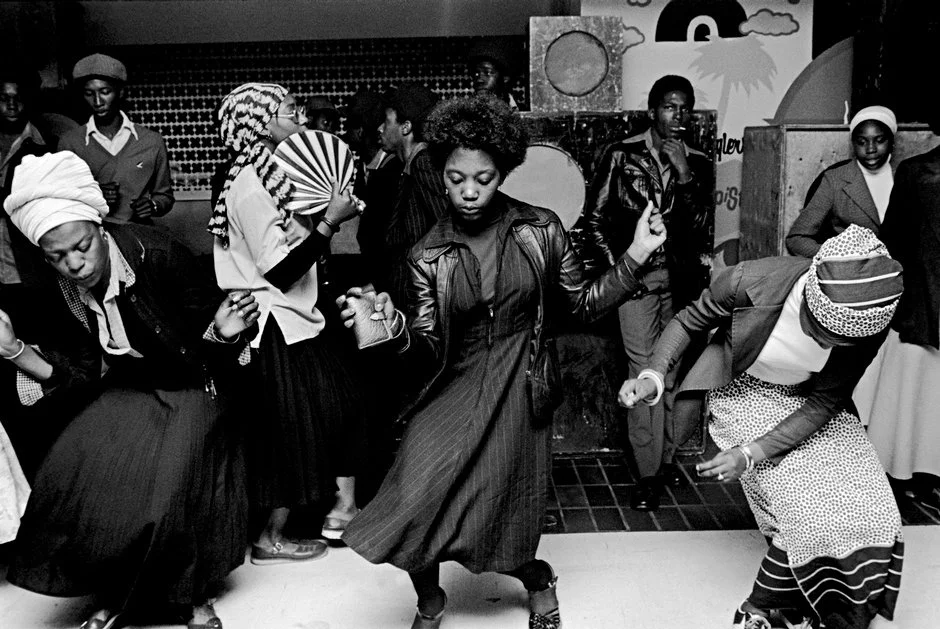
For The Sunday Times, Steele-Perkins explored Wolverhampton’s sports clubs, playgrounds, and other spaces where the region’s Asian and African-Caribbean population gathered or worked that year, photographing what he could.
Settings like the one depicted here—an informal, improvised space made available for sound-system parties that were soundtracked by roots reggae and dub records—were increasingly important to Britain’s Black immigrants during the 1970s and earlier, especially as their functions were targeted by police, they were excluded from white pubs and nightclubs, and were victimized by their white neighbors. Legislators presented another challenge in their endeavors to limit civic space where immigrants of color could convene.
“The people in this club weren't all that young, and I think they were there because there weren't many options if you wanted to go and dance to reggae,” Steele-Perkins said of his portrait’s subjects.
When my partner and I visited London this summer, I was grateful she made sure we saw “The Music Is Black.” Curated by Jacqueline Springer, the exhibition contextualizes the enduring impact of Black British music and doesn’t shy away from probing the effects that the slave trade, music-industry racism, and widespread anti-immigrant sentiment have had on Black British music culture and artistry over the years. The show’s instruments, archival footage, vintage fashion, objects, and photographs such as this one draw from four continents and pertain to all strains of music such as jazz, Black British classical music, and reggae.
It’s hard to overstate what reggae meant to Britain’s immigrants who were raised in Caribbean households and how popular the form was in the UK when Chris Steele-Perkins was photographing Wolverhampton. Reggae-centric radio programming debuted in the early 1970s in Britain, and, in the immediate vicinity of the youth club in Steele-Perkins’s photograph, around the time it was taken, Wolverhampton’s own reggae act Capital Letters were potentially rehearsing their new Greensleeves single, “Smoking My Ganja” (a fave of BBC Radio 1’s John Peel). Birmingham’s Steel Pulse issued their debut LP in 1978, too.
A mere five years before Steele-Perkins took this picture, Trinidadian Londoner Leslie Palmer would substantially alter Notting Hill Carnival forever when he invited reggae bands and sound systems to the widely attended annual celebration. “It was through this that Palmer bridged the gap between the festival’s Caribbean heritage and the first generation of British-born Caribbeans, disinterested by Carnival, but who flocked around sound systems,” reported Rolling Stone’s Jess Cole in 2023.
The term “sound systems” refers to both the custom hand-built audio gear hauled into public during outdoor dances and sound clashes in the streets of 1940s Kingston, Jamaica (turntables, tube-driven amplifiers, and speaker stacks), as well as to their human operators and affiliates. By the 1960s, these systems had been emerging in London, with Duke Vin establishing himself as a selector in Ladbroke Grove as early as the mid-1950s.
In postwar Britain, there wasn’t a sizable Black population into which Black youths from Caribbean nations could merely integrate. Small parties known as “blues dances” were held in immigrants’ homes or unlikely, non-commercial venues. They featured the UK’s earliest sound systems and afforded the region’s newcomers the chance to gather with one another, eat home-cooked meals, and immerse themselves in American rhythm & blues records.
During the 1960s, the heavenly harmonies and staccato guitar stabs of Jamaican ska and, later, rocksteady 45s, could be heard on local sound systems at blues dances staged in homes and cooperative spaces like the church youth disco club in Steele-Perkins’s photograph.
As they relate strictly to music, sound systems and the British sound system boom of the 1970s were central to the broader popularization of reggae in the United Kingdom. They were critically meaningful to the flourishing experiments of dub, with King Tubby’s Hi-Fi, Saxon Sound, and Channel One all having set up shop in various London boroughs during the decade. But sound systems were also crucial social hubs that provided safety and community in hostile corners of British cities. The spaces in which the Caribbean community could get together and celebrate their culture were sacred and empowering.
Sound systems were “the first large cultural expression that downtown Jamaicans had to call their own,” Bass Culture author Lloyd Bradley told the Rock’s Backpages podcast. “They thought it up. They owned it. It was so important to them. It was more than just somewhere you went, somewhere you listened to music. This was where you could be you.”
In this image, Steele-Perkins’s poignant documentation of one such space, the details are crisp, and the busy composition whisks us squarely into the center of the room.
Note the swoop of the long skirts and wrap dresses worn by the confident, low-crouching women in the foreground. The dancers, with their finger snapping and determined expressions, are mid-sway, eyes fixed on their own lower-body movements and the floor beneath them. They’re deeply absorbed in the moment, as is the shuffling figure positioned center-left who extends an open hand fan toward her face. Toward the rear of the room, a leather trench-clad onlooker posted-up alongside the system’s custom-built wooden speaker box is understandably eyeing the outsider photographer with suspicion.
The dancing here is communal, joyous, political, and rebellious all at once—a complex practice that allows for both celebration and an open defiance of oppression.
“I probably sell more prints of this picture than any other, which is bizarre because I didn't really like it at the time,” Steele-Perkins told The Guardian in 2014. “It's grown on me, though, and it seems to have caught the popular imagination.”
Disco in Wolverhampton, Wolverhampton, 1978 © Chris Steele-Perkins for Magnum Photos.
