Tim Lane’s “Abolish ICE” poster
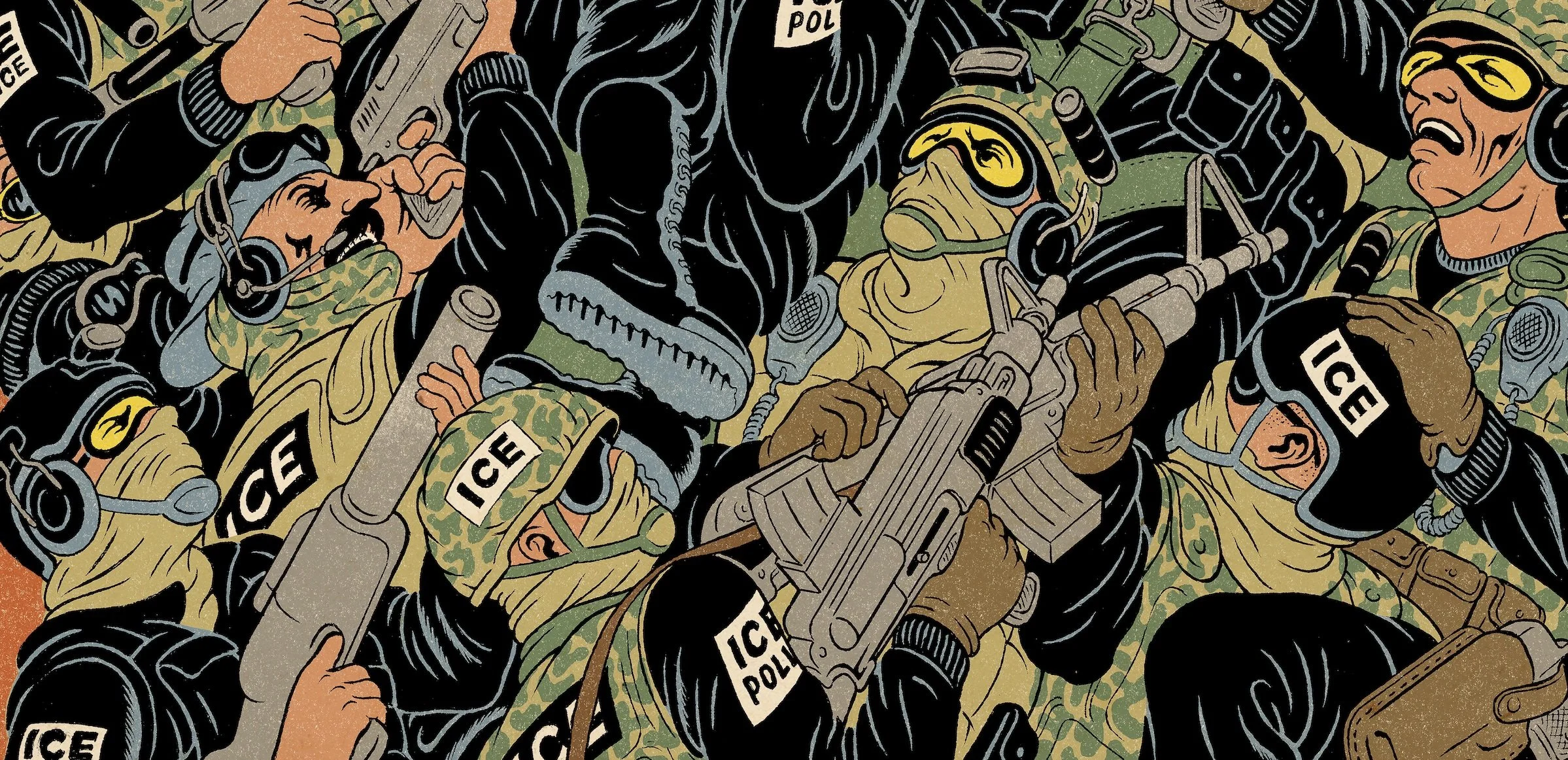
Clad in camouflage neck gaiters and other tactical military gear, a horde of U.S. Immigration and Customs Enforcement (ICE) agents work to forcibly scale, stifle, and eventually arrest the Statue of Liberty in a recent drawing by Tim Lane titled Abolish ICE for Liberty’s Sake.
They tote automatic rifles or swing nightsticks, and one of them snakes his way toward Lady Liberty’s wrist, his handcuffs dangling just below her torch, an emblem of progress encircled in a decorative band of copper leaves. Lane’s thugs, incensed and set against a fire-orange backdrop, are in attack mode, throwing their fists and thrusting their boots, invasively jabbing and piercing the folds of her robe with their gun muzzles.
When I look at the St. Louis illustrator’s protest art, I can almost see the government officer who killed unarmed American activist Renée Good in the middle of a street in Minneapolis. It happened on January 7th, right after she dropped one of her children off at school, and it was the first of two deadly Department of Homeland Security (DHS)-involved shootings in Minnesota at the start of this year. I can practically visualize the agent who took her life—the other agents’ open rage and cursing; guns drawn; the look of surprise on Good’s face; and her effort to diffuse all of it (“I’m not mad at you”). Elsewhere in Lane’s mob, I can nearly make out the federal immigration agents who shot and killed ICU nurse Alex Pretti, too.
Before they killed him, mere weeks after Good was killed, the agents pepper-sprayed and viciously beat Pretti, a protester and 37-year-old employee of the Minneapolis Veterans Affairs Health Care System. And then, while he was on his back, they shot him in the street, in the town where he lived.
In the poster’s pile-on, I can almost see the officers who swarmed a residential block in Columbia Heights, Minnesota, days before the nurse was shot to death, to detain five-year-old Liam Conejo Ramos and his father. Earlier, in the fall of last year, 20 heavily armed border agents rushed into a laundromat in Chicago in order to take a mother and her five-year-old daughter into custody. Those guys probably looked a lot like the goons in Lane’s drawing, too.
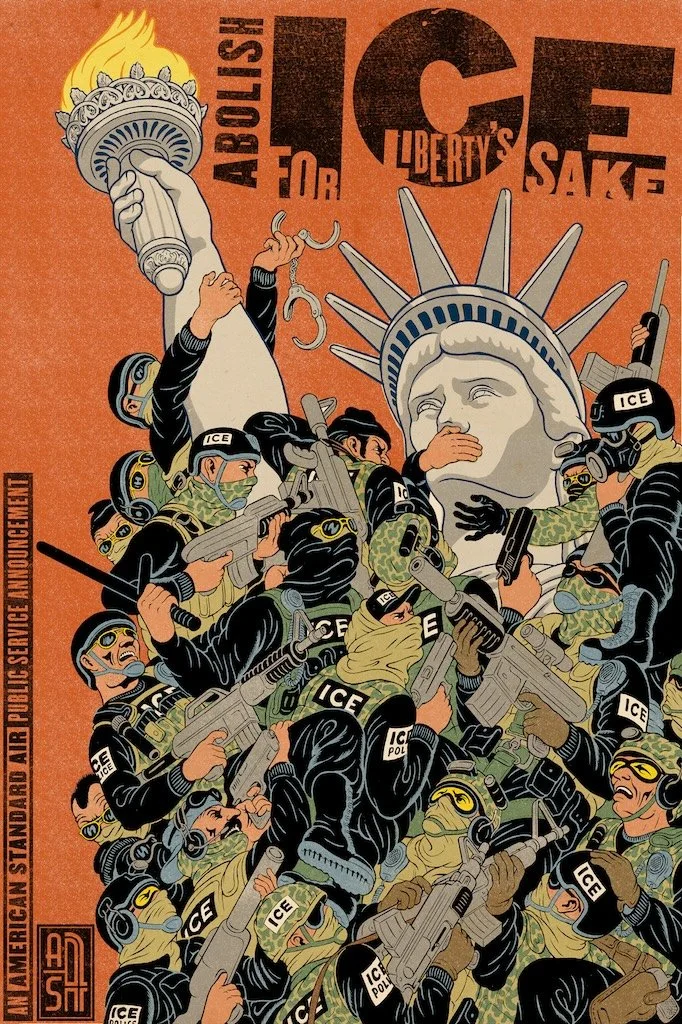
The Statue of Liberty has emerged as a common motif for artists who’ve targeted ICE in their work over the last year. Initially conceived by French abolitionist and political thinker Édouard de Laboulaye—and designed by French artist Frédéric Auguste Bartholdi—the 19th-century sculpture was intended to mark America’s independence and celebrate the abolition of slavery in the United States.
The statue was also in part a critique of the authoritarian regime of Louis-Napoléon Bonaparte, a self-styled populist “strong man” who, while president and facing the expiration of his term, orchestrated a bloody self-coup to topple the government in order to remain in power. Thousands were deported or arrested in the streets as Bonaparte dissolved the existing parliamentary democracy, regularly issued bulletins to bolster his incessant self-mythologizing, and ordered the censoring of dissenting French newspapers or had them shuttered entirely.
After Napoleon III had been deposed, construction of the Statue of Liberty began, and as part of a fundraising effort to secure a pedestal for the monument, Lady Liberty’s arm and torch were displayed at the 1876 Centennial Exhibition in Philadelphia.
A poem called “The New Colossus” was read at a fundraising event for the pedestal in New York. Its author, a working writer named Emma Lazarus, had been volunteering at an organization to support Ward’s Island’s newest immigrants. She had Russian Jewish immigrants in mind when she cast the Statue of Liberty as the “mother of exiles” in her sonnet. A bronze plaque with Lazarus’s poem was mounted inside the statue’s pedestal in 1903.
A hundred and forty years after the dedication of the Statue of Liberty—and nearly five months to the day of Good’s death—Congress voted to funnel approximately $70 billion to the DHS for ICE and Border Patrol. One month after our legislative branch surrendered more money to these operations, over the course of a week, ICE agents:
shot and killed Lorenzo Salgadao Araujo, an unarmed Mexican immigrant and father of three, on his way to work in Houston, Texas;
fatally shot Joan Sebastian Guerrero, a 26-year-old Maine father from Colombia who was authorized to work in the United States;
and, in Florida, chased a 28-year-old man who was subsequently struck and killed by a tractor trailer during the pursuit.
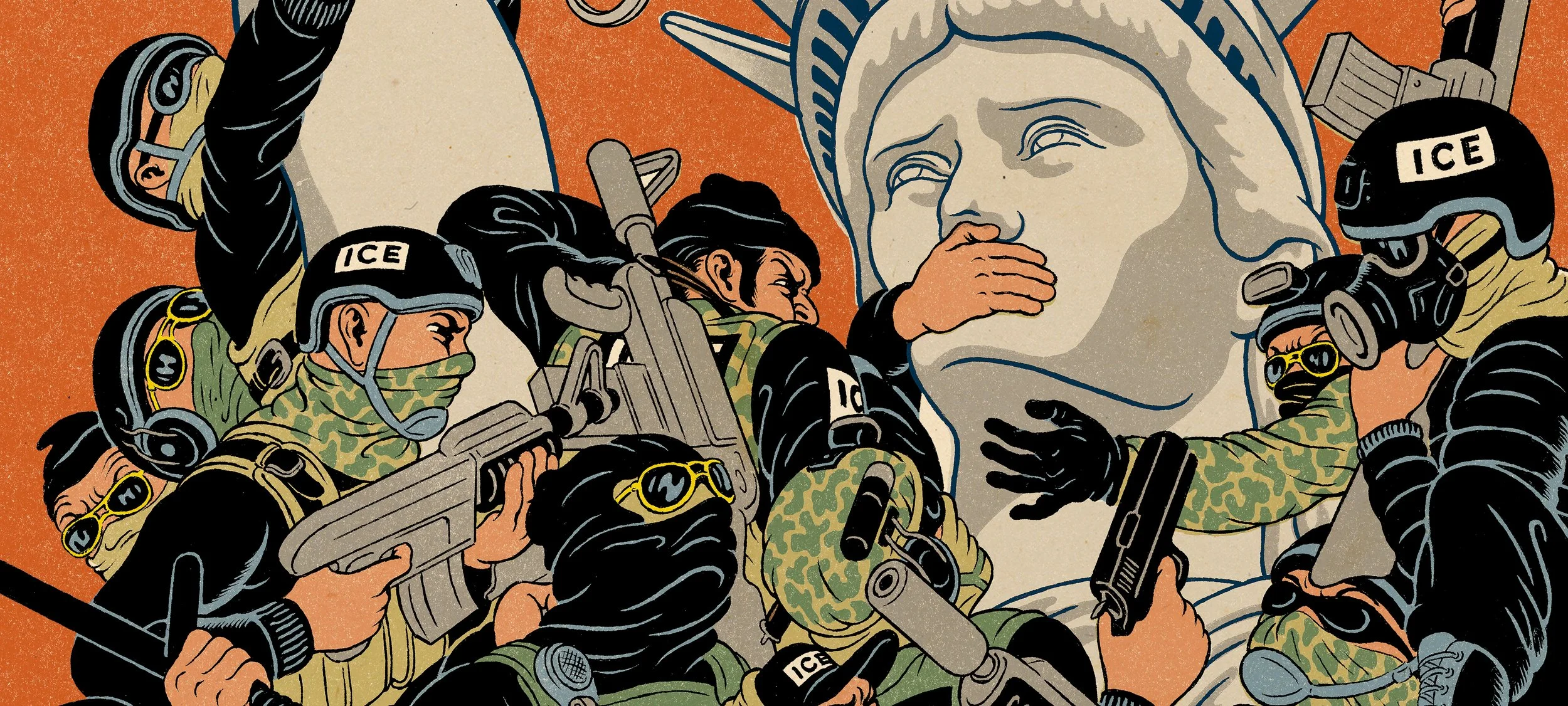
While it’s true that Tim Lane was following news coverage of ICE’s occupation of American cities when he posted Abolish ICE for Liberty’s Sake to Instagram in February, he ordinarily mines the past for inspiration.
The artist’s innovative graphic anthologies, such as The Lonesome Go, are chock-full of overtly cinematic comics stories, prose, and fussily detailed free-standing illustrations that draw on mass media and consumer culture.
As I wrote for Hyperallergic in 2014, Lane’s work owes visually to vintage EC Comics titles, old television shows, and postwar commercial graphic design, with the artist sometimes creating his own dazzling, mid-century–style advertisements for products that don’t exist. When he drafted the poster, however, he was responding to the moment.
By the time Abolish ICE went online this year, at least six people had died in ICE’s custody, not counting the two who were fatally shot. The Trump administration was ramping up its so-called “immigration enforcement” efforts, and several thousand officers under the Homeland Security umbrella were deployed throughout the Twin Cities region by December of 2025 in service of “Operation Metro Surge.”
This program shouldn't have surprised anyone, much less the deluded, morally bankrupt Trump voters who are now telling reporters that they regret casting their ballots for a twice-impeached convicted felon who enjoyed a personal relationship with the world’s most famous pedophile.
Throughout 2024’s presidential campaign, Trump’s team promised a “most spectacular migration crackdown.” Everyone heard him, so when your neighbor tells you they “didn’t vote for this,” welp, it’s very likely that they voted for this.
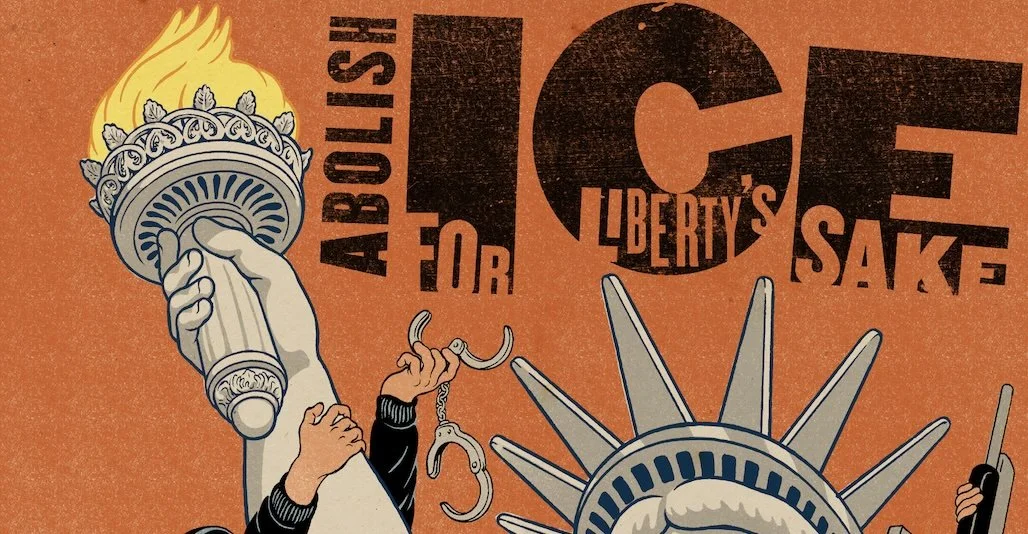
Just as it does in the work of Ed Ruscha—a Nebraska-born fine artist who is similarly preoccupied with consumerism and mass media—text plays an outsized role in Lane’s graphic narratives, which often feature word art and audacious typographic choices that are linked to a story.
The “American Air Standard Public Service Announcement” branding and logo at the bottom-left of Lane’s poster art are hallmarks of the artist. In Lane’s books such as Abandoned Cars, the text appears as a disclaimer in clever spoof advertisements—in the MAD magazine tradition—for fictional products and services. On the other hand, the “Abolish ICE for Liberty’s Sake” header text that nearly crashes into the artwork’s top-right corner is quite meaningful and connected to our reality. It has the grainy, smudged appearance of stenciled street art and mimics that of a comic book’s interior title page. Lane’s header emphasizes the fact that an ungoverned agency hell-bent on destruction cannot possibly be reformed despite what establishment Democrats would have you believe.
Our only option is to shut ICE down, and now the program has enough funding to sustain it through the rest of Trump's term.
On that frigid Saturday in January after the news broke of Alex Pretti’s death, we bundled up and took to the streets in Manhattan to voice our outrage at what was happening in Minneapolis and elsewhere. A rally in Union Square preceded the march. We gathered in the central plaza area, not far from the park’s bronze sculpture of the Marquis de Lafayette, the French officer who volunteered to fight alongside George Washington in the American Revolutionary War. The monument was designed by Frédéric Auguste Bartholdi and was dedicated a decade before his Statue of Liberty was formally unveiled in New York Harbor.
It was chilly, but the temperatures in the park were nothing compared to what Minnesotans were navigating while they desperately wedged themselves between their neighbors and “Operation Metro Surge.” For us, it was solidarity. For Minnesota, it was life and death.
“I refuse to call them law enforcement,” New York City Council Member Chi Ossé said of ICE while addressing the crowd that afternoon. “They are agents of chaos. They are destroying the fabric of the country.”
For centuries, artists everywhere have illuminated pressing social and political issues of the day, and some works are imbued with more urgency than others. For example, in any given piece, you might encounter bottomless horror that feels tangible and immediate, wherein its maker is sounding an alarm to draw attention to government-sanctioned lawlessness so vile that it can barely be confined to an 11-by-17-inch print. When I look closely, I can see that vile lawlessness in Tim Lane’s poster.
Abolish ICE for Liberty’s Sake © 2026 Tim Lane.
