Listening and links: 35 years of Cypress Hill’s debut
Reading recommendations and absolutely no sample snitching ahead.
CYPRESS HILL’S DEBUT AT 35
In 1991, rather than rely on the funk and soul samples that backed the majority of the day’s rap singles, producer Lawrence “Muggs” Muggerud mostly worked instead from a crate of hard rock and psychedelic records to craft a provocative, sonically spirited tapestry for Cypress Hill’s self-titled debut album. The legendary Latin American Los Angeles hip hop trio’s certified double-platinum first LP hit shops 35 years ago this past August.
Today, when he isn’t cooking up beats for gritty contemporary underground hip hop projects, Muggs’s influence is all over them. In the three and a half decades since the Philadelphia-based, Columbia-owned Ruffhouse issued Cypress Hill’s debut, Muggs has earned several Grammy nominations; worked with the likes of GZA, Roc Marciano, and Janet Jackson; and mentored Alchemist. But he was something of a newcomer in 1991. He looked back on Cypress Hill during an interview with Questlove in July:
Questlove: I tend to judge people not on the hit singles, but the filler. So, just all the crazy psychedelic shit you're doing on “Stoned Is the Way of the Walk”—and especially at the end—can you talk about the process of putting that record together? Because it just sounds like nothing that was ever released and (there’s) a lot of rule-breaking on it.
Muggs: Yeah, (it’s) very unorthodox, you know what I mean? It's just trying to find our own sound because it was important then, to have your own sound, your own look, and have your own slang, too. And it was interesting because you have…I was inspired by New York production. So you had a New York production with West Coast slang on it and West Coast emcees. So it was a whole new sound and style.
By the time Cypress was tracking demos, the Queens, New York–born Muggs had been living out on the West Coast in Bell Gardens, California, for less than 10 years. In that time, he’d honed his skills behind the decks and won a bunch of DJ contests, including the prestigious DMC West Coast title in 1989. In 2022’s Cypress Hill: Insane in the Brain documentary, former KDAY DJ Julio G recounted a visit to Muggs’ Bell Gardens home in the early days.
“I go to his house, and I was like, ‘Damn, this dude is serious’ because all he has is some records, his dresser, turntables, his bed…and a poster, and that was it.”
Muggs helped promote park jams and backyard parties in the southeastern LA neighborhood that differed little from the formative parties in his native city. His earliest steady musical project was DJing for the short-lived Los Angeles group 7A3, which had a connection to the urban metropolis that was home to his biggest inspirations.
“My favorite shit was Ultramagnetic [MCs] or Public Enemy,” Muggs told author Brian Coleman for Check the Technique: Liner Notes for Hip Hop Junkies. “And with PE, there was just always something going on with their music. There were sounds that only happened in the chorus or different verses, sounds that would happen for two bars in the second verse that didn’t happen for the rest of the song. That kind of influence was where I came from.”
The 7A3 single “Coolin' in Cali” was produced in 1988 by Long Island’s Bomb Squad, a beatmaking collective best known to listeners of a certain vintage for the aggressive and often chaotic beds of sound it created for pivotal albums such as Public Enemy’s It Takes a Nation of Millions to Hold Us Back and AmeriKKKa's Most Wanted, Ice Cube’s solo debut following his exit from N.W.A. In the distinctive, dusty-sample-driven backdrop of Cypress Hill’s inaugural LP, there are definitely shades of the textures that the Bomb Squad was building for PE at Greene St. Recording in Manhattan’s SoHo neighborhood. (Ruffhouse cofounder Joe "The Butcher" Nicolo, who engineered Cypress’s debut, also worked with 7A3.)
Muggs’s affinity for another crew of Long Islanders should be noted here, too. De La Soul incorporated pitch-shifting, filtering, diverse sample sources, and a pioneering layering of those sounds on 3 Feet High and Rising, the group’s 1989 debut LP. The album makes plain that the three-piece and its producer, Prince Paul, were mighty adventurous when it came to flipping samples. Muggs felt similarly, so much so that he modeled “How I Could Just Kill a Man” after De La’s “Plug Tunin'.” And because Muggs didn’t have the Manzel record that De La looped-up for the song, he lifted the break directly from De La Soul’s 12-inch to use for the Cypress Hill track.
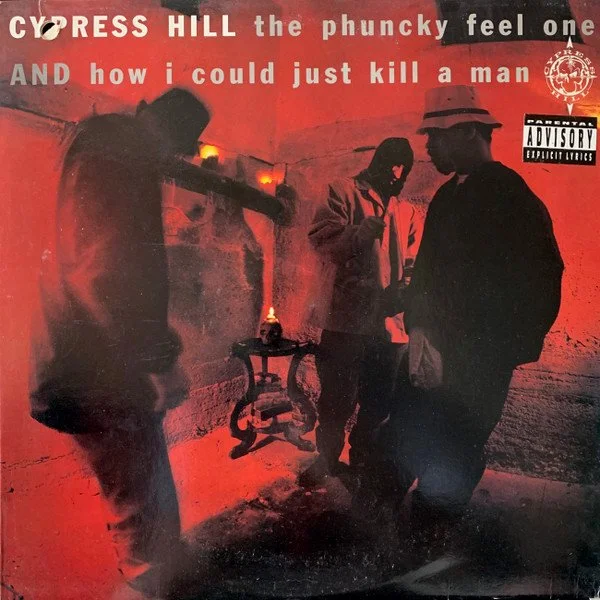
Paired with hard kicks and sinister bass lines, Cypress Hill’s shrieking fuzzbox-guitar riff loops curl around hooks or simmer in the background of verses from B-Real and Sen Dog on the influential “Hand on the Pump,” “How I Could Just Kill a Man,” and “The Phuncky Feel One,” which landed on Billboard’s Year-End Hot Rap Singles in 1992 and is frenetic enough to be mistaken for a …Nation of Millions… B-side. The group’s frontmen spin convincing gangland yarns on their breakout full-length and make a worshipful pitch for cannabis use so unwavering that Snoop’s looks lifeless in comparison. In 1993, Muggs fired up a joint onstage during the group’s Saturday Night Live appearance. They were not invited back.
The album’s barrage of snare cracks, slow-burning raga drones, and bursts of noisy sound collages—courtesy of Muggs and his E-mu SP-1200 drum machine—were among the characteristics that set it apart, production-wise, from landmark offerings by Gang Starr, Black Sheep, and others in 1991. While it’s true that Muggs had the soft spot for sampling Jimmy McGriff or the J.B.’s that his peers had, the Stax soul and Blue Note LPs that beatmakers like Premier favored at the time weren’t exactly the go-to sources for him.
Muggs tells Quest that he scooped up every installment of Ultimate Breaks and Beats and scoured dollar bins in search of organ loops or bits of amp feedback from neuron-cell-frying missives by Funkadelic, Jimi Hendrix, or the wonderful one-offs preserved on Nuggets compilations rather than soul or jazz. Muggs’s digging wasn’t strictly confined to heady jams, however, and there was expectedly some overlap between Cypress’s production and other rap at the time.
A Tribe Called Quest’s Low End Theory wasn’t the only record that swiped Neal Creque’s organ stabs in 1991, for example. That particular loop, from Grant Green’s Alive!, simultaneously showed up on Muggs’s beat for “Stoned Is the Way of the Walk”—and the drum break from Lowell Fulson’s “Tramp” that powered EPMD’s hardcore banger “Rampage” did the same for Cypress Hill’s “How I Could Just Kill a Man” (he dug the Otis Redding and Carla Thomas version, too). And listeners have detected bits and pieces over time from standbys Kool & the Gang, the Bar-Kays, and other likely sources woven into Cypress Hill’s collagist textures. On the other hand, you didn’t really hear Gene Chandler’s “Duke of Earl” samples popping up on Yo! MTV Raps. Cypress paid a lump sum of $50K for the “oldie” R&B hit—a snippet of it famously opens “Hand on the Pump.” Nor were rap producers generally mining Are You Experienced for guitar lines.
For Muggs, the refreshing influence of psychedelia and classic rock that informed Cypress’s debut and—even more so—its moody 1993 follow-up, Black Sunday, came from an uncle who lived at his family’s home when he was a child.
“He had velvet posters, black lights, eight-track tapes on the wall,” Muggs tells Questlove of his uncle’s love for rock. “And beads, incense, you know, he was into rock. So listening to Led Zeppelin, Jimi Hendrix, you know what I mean? That was, like, my intro to music right there.”
Questlove’s whole interview with Muggs can be found wherever you listen to podcasts.
QUICK HITS
Postwar artist S. Neil Fujita designed ~50 album covers for Columbia in the late 1950s—he's one of six Japanese-American artists featured in a new Barnes Foundation show. Nate Chinen wrote for WRTI about the exhibition.
Read this extensive unpacking of the Easy Rider soundtrack by Elizabeth Nelson—if you’ve been put off by the hit singles, Steppenwolf's debut LP is sort of a secret shredder (grab the Mars Bonfire stuff, too).
I loved this personal piece by author Lloyd Bradley on Notting Hill Carnival, which was altered significantly when Trinidadian Londoner Leslie Palmer invited reggae bands and sound systems to the annual celebration. Relatedly, I wrote recently about an image captured by British-Burmese photojournalist Chris Steele-Perkins in Wolverhampton, England, in 1978.
At London Review of Books, Adam Shatz writes about a book of Lisette Model’s mid-century-era jazz photography that is seeing the light of day for the first time. The Austrian-born American street photographer’s project lost its funding from philanthropist Helena Rubinstein when Model was targeted by U.S. Senator Joe McCarthy and his ilk for alleged Communist sympathies/leftist activities. A reported letter to Rubinstein from Harper’s Bazaar editor-in-chief Carmel Snow—who’d long been running Model’s photography in her magazine by then—warned that Model was a dangerous troublemaker. Not cool, Carmel. See also Vince Aletti on Model’s “unintentional fashion photography.”
We play a lot of John Coltrane around here, centennial or not. My first listen on September 23rd—which would’ve been his 100th birthday—was Olé Coltrane. His modal work is among my favorite jazz, period, and it influenced all kinds of musicians, including psychedelic rock groups. Here’s Mark Stryker on the “Tiberi Tapes” and Hank Shteamer on Coltrane’s obscured role as the founder of the “unofficial movement” known as “spiritual jazz.”
A new Jack Shainman Gallery show "revisits images by Gordon Parks through the reflections of the people and families he photographed." You should also go see Becky Suss’s paintings, which are on view through October 31st.
At Hearing Things, an eye-opening post explores the broader implications of "pop culture’s deep fascination with codeine and promethazine, the two primary components of the syrupy narcotic drink best known as lean" and its obsession within hip hop.
